
 English
 Français
 Deutsch
 繁體中文
 日本語
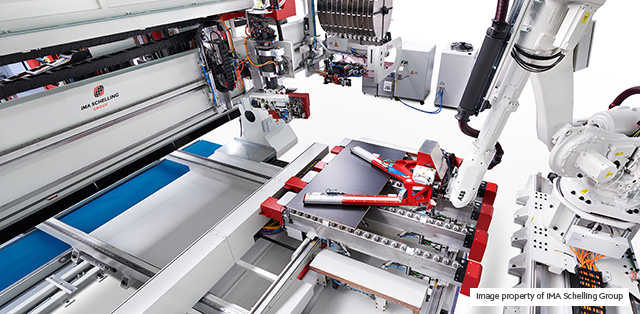




Company mergers often entail change projects: Different processes, data models, and IT landscapes must be balanced. IMA Schelling faced another task. What began as an IT integration project soon developed into something bigger. More and more company divisions discovered the benefits of a common database, far beyond the classic PLM areas of engineering and design.
About IMA Schelling Group
The IMA Schelling Group is a leading international supplier of high-tech and integrated production systems for the wood, metal and plastics processing industry. The company combines engineering, software, and modern technologies to create high-performance concepts for efficient manufacturing processes – from individual machines to fully networked production infrastructures. With 2,000 employees, a turnover of 350 million euros, and a global network, IMA Schelling develops and implements custom-built solutions that guarantee transparency, stability, and high performance over the entire life cycle.
Context
IMA Schelling was faced with the challenge of merging two established organizations with different processes, data structures, and IT landscapes. The company relied on a solution that accounted for the locations’ proven ERP structures while also creating a common, cross-site basis. In this way, the existing systems could continue to be used and meaningfully connected to one another through a uniform view of products and articles.
This was a complex project, as product-relevant information was distributed across several systems, and article master data, CAD data, and documentation were maintained in proprietary applications. It was time-consuming to provide product information consistently and make it available across company boundaries.
Different data models and separate processes made the procedure even more difficult. A common information foundation became a prerequisite for the further integration of the two companies.
PLM Solution Requirements
The objective was clear: make product information available across systems, reduce redundant data storage, and merge different data sources without fundamentally changing the existing ERP systems. At the same time, the solution had to be flexible enough to support existing processes and adapt to future requirements.
With Aras Innovator, IMA Schelling opted for a PLM platform that pursues exactly this approach. Instead of replacing existing systems, information from different sources is merged into a common product database. For the first time, this created a consistent view of products and articles across company and site borders.
Success with Aras Innovator
Shortly after launch, it became clear that the Aras Innovator PLM platform could do much more than integrate disparate data sources.
The system has simply become more established because more and more departments wanted to be connected to the system.
Oliver Pallerberg, Leiter Technical Systems, IMA Schelling
What was originally designed as a common product database for engineering and master data management gradually developed into a central source of information for other areas of the company. Specialist departments recognized the benefits of a common view of product information and formulated their own requirements for the system.
In this way, additional information and processes were gradually integrated. Today, the following departments use the same product database:
- Documentation
- Assembly
- Shipping
- Customs
- Service
As a result, consistent information is available across departments, regardless of which ERP system or original corporate structure it comes from.
Take customs tariffing, for example. Previously, customs-relevant information was not recorded consistently across all locations. Today, it is directly linked to the respective article. As a result, it is centrally available to the shipping, logistics, and other specialist departments. Automatically generated customs data sheets, along with stored dangerous goods and shipping information, provide smoother processes and significantly higher data quality.
In assembly, the central data foundation is changing daily work. Instead of classic assembly drawings, many employees today use 3D models directly in the PLM system. With the help of the 3D viewer integrated in the Aras Innovator, they can analyze assemblies, create sections, or call up expanded views. This puts product information directly into the context where people work.
With each new requirement, the platform continued to develop. Instead of creating isolated solutions for individual departments, a common information basis was created step by step, connecting more company divisions. This development is also reflected in the use of Aras Innovator. Today, roughly 400 employees are actively working with Aras Innovator. A further 400 users worldwide access the same product database.
The use has expanded significantly. Originally, it was mainly about the management of articles, article information and CAD data. Today, we also use the system for documentation, compliance processes and risk assessments. At the same time, more and more requirements from other areas of the company are being added, which we map in the system.
Thomas Hampel, Leiter Innovation/Component Management and Technical Support, IMA Schelling
Today, development is no longer carried out solely on the basis of technical requirements. Rather, new use cases are created directly in the specialist departments. Employees recognize additional application possibilities, contribute new ideas, and continually expand the platform’s uses. As a result, the integration project has evolved into a solution whose further development is significantly influenced by user needs.
Results
Now, Aras Innovator forms the central access point for IMA Schelling’s common product database. Information gathered from different systems is available across the company and can be used independently of its original source. This significantly reduces duplicate maintenance, media breaks, and time-consuming coordination.
Today, we actively use the data to analyze and improve our processes. With the help of reports and key figures, we can track processing times, changes and process flows and optimize them in a targeted manner. This helps us to continuously develop our business processes.
Thomas Hampel
The biggest change, however, is not only greater transparency but also the recognition that product information is now understood as a shared resource. Decisions are based on a uniform level of information, and processes can be better coordinated across departments.
At the same time, this common database serves as the basis for subsequent digitization steps. Future AI applications can also be based on an information base that has grown continuously over the years, rather than on isolated solutions.
We are already using PLM data to create maintenance instructions. For example, we analyze parts lists and automatically recognize which components are installed.
Thomas Hampel
Outlook
The potential of the common product database is far from exhausted for IMA Schelling. With each expansion, new applications emerge that are based on shared information. In the future, the focus will be on mapping as-built structures using Aras Digital Twin Core, integrating software BOMs, and the targeted use of AI. The goal is to make more comprehensive use of product information, to further automate processes, and to enable new digital services.
A successful PLM implementation brings different system environments together around a common information foundation. That shared foundation becomes the company’s digital backbone. Here, product information from different sources converges and is available across departments for ever new applications – all the way to future AI applications.
Oliver Pallerberg summarizes the fundamental role that PLM played:
If I had to sum up the last few years in one term, it would be transparency. Today, PLM is a kind of backbone in which information converges and is distributed from there in a targeted manner.
Oliver Pallerberg